







This week, I posted a mini rundown of interesting screenshots I’ve collected lately from other marketing newsletters I follow.
One that got a lot of traction was about the new trend of “lurking” vs. engaging…which might actually feel encouraging if you’ve noticed your social posts aren’t getting the same traction they used to.
But social engagement isn’t the only thing on the decline.
Search metrics are, too. (Generally speaking, across the board.)

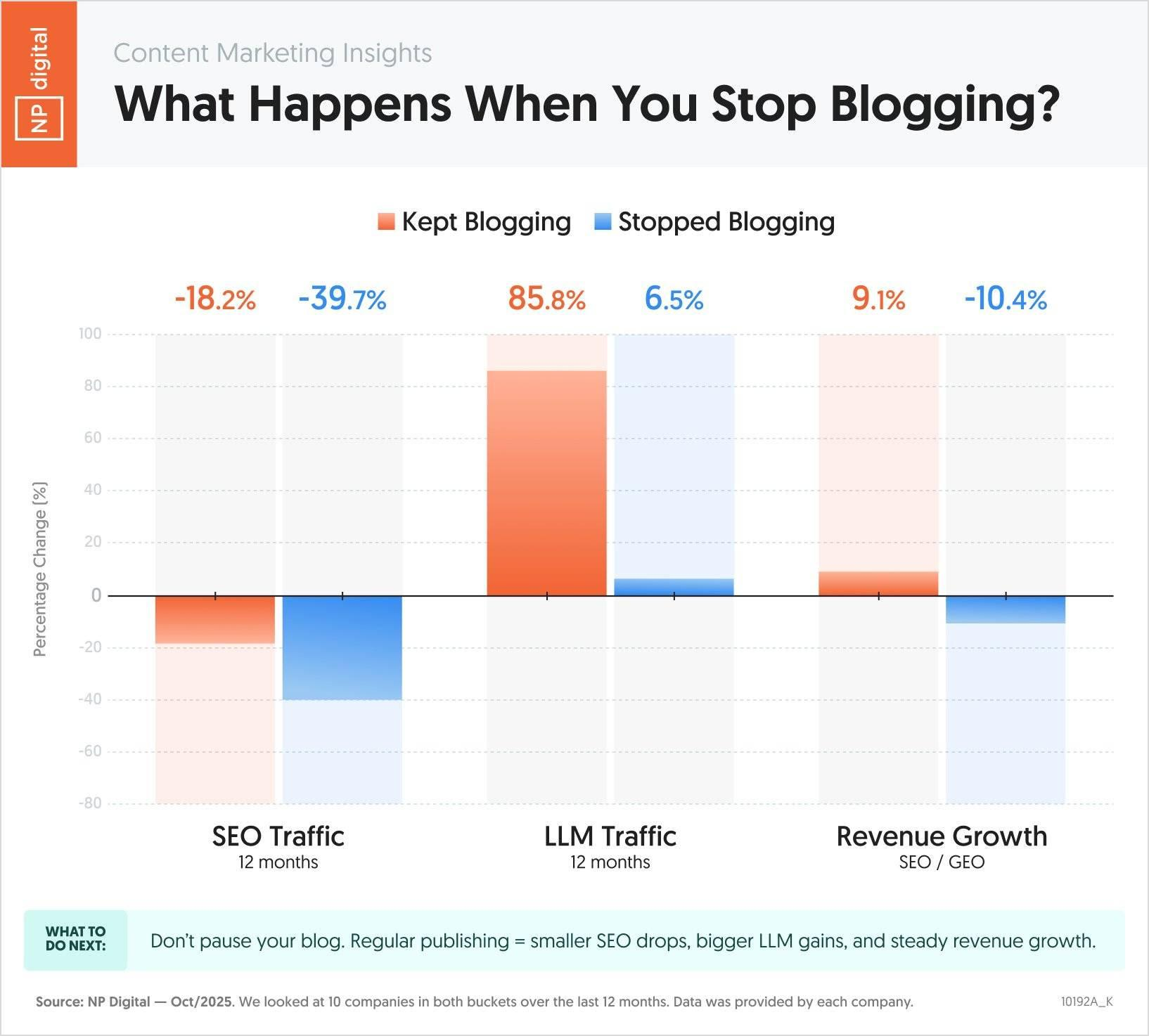
This chart is talking specifically about what happens when you start or keep blogging, but it reinforces the idea that SEO traffic is down across the board and helps lead us to our next point here…
According to SparkToro and SimilarWeb, only 18% of Google searches now lead to a website click.
People are efficient (cough, lazy, lol). They read the Google AI overview and move on instead of ever clicking into the article or visiting the website itself.
And with behavior change comes…
🥁drumroll🥁
Marketing change!

If you type this prompt into ChatGPT, it’ll give you a super detailed (and honestly, probably a bit overwhelming) list of steps to help you show up higher in AI-driven search results:
“I’m a holistic health practitioner who wants to show up higher in AI search results (like Google’s AI Overviews or ChatGPT browsing). My practice focuses on [insert specialty — e.g., Ayurveda, acupuncture, integrative nutrition, etc.] and I serve clients in [insert location]. Please analyze my website [website url] and tell me, in plain language, exactly how to optimize it for AI search discovery.”
chatGPT prompt
How do they decide what’s “trustworthy,” you may ask?
They look to God…sorry, I mean Google.
Google uses a quality framework called E-E-A-T:
E – Experience
E – Expertise
A – Authority
T – Trust
In practice, that looks like this 👇🏼
- Include your bio and credentials – years of experience, certifications, where you studied, etc.
- Use first-person examples to prove experience (“In my 30 years as a clinical professional…”).
- Link out to credible sources (NIH, PubMed, or even the classical texts of your own modality).
- Add client testimonials – especially those that mention tangible outcomes (AI loves context).
And if you have <5 min to spare, start here:
✅ Add your city + modality to your footer (if you’re a local clinic).
✅ Turn a few FAQs into short blogs.
✅ Link your socials to your site (and your site back to your socials).
✅ Publish your bio in first person. (AI prefers real, human narrative over robotic, formal, third-person bios, which is hilarious if you think about it too hard)






+ show Comments
- Hide Comments
add a comment